

Otrigal Your world. In your hands.
The internet rarely leaves a space empty for long.
In November 2023, Omegle shut down after fourteen years of operation, ending one of the most recognizable experiments in internet history. The idea behind it was radical in its simplicity: press one button, and you are face to face with a complete stranger from anywhere on Earth. No profiles, no followers, no algorithm deciding who you should meet. For millions of people, Omegle was their first experience of what it truly meant to talk to strangers online.
Its closure was the end of an era, and the start of one of the largest user migrations the social internet has ever seen. Overnight, millions of people began searching for an Omegle alternative that could carry the idea forward.
From Omegle to Otrigal: A New Direction for Online Conversations
The market responded quickly. Platforms such as OmeTV, Chatroulette, Emerald Chat, CamSurf, Chatspin, and mobile-first apps like Monkey App absorbed much of the demand. Each brought its own interpretation of random video chat: some focused on interest-based matching, others on filters, speed, or community features. Search interest for terms like “video chat with strangers” and variant spellings such as “Ome TV” surged as users hunted for a new home.
But the migration also exposed an uncomfortable truth. Connecting two strangers on video is the easy part. Doing it responsibly, at global scale, is one of the hardest problems in consumer technology.
Omegle’s own shutdown made the stakes clear. A stranger chat platform cannot survive on spontaneity alone. The platforms that inherited its audience now face the same defining challenge: preserving the thrill of meeting someone new while protecting the people doing the meeting.
The Hardest Problem in Social Technology
Modern anonymous video chat platforms process millions of real-time interactions every day. Behind every connection, systems must detect spam, bots, and inappropriate content within seconds, without disrupting genuine users or violating their privacy. Too little moderation, and a platform becomes unsafe. Too much friction, and the magic of spontaneous random chat disappears entirely.
This is the balance the entire category is now judged on. The next generation of stranger chat platforms will not win by connecting people faster. They will win by connecting people better.
Enter Otrigal
Into this evolving landscape steps Otrigal, a browser-based platform built around a straightforward belief: meeting new people online should be instant, simple, and responsibly designed from day one.
Otrigal does not position itself as a replacement for what came before. It joins the new generation of platforms rethinking anonymous video chat from the ground up, with modern infrastructure rather than legacy code, and with moderation treated as a core feature rather than an afterthought.
The platform offers dedicated experiences for both video and text. Visitors can explore the service at otrigal.com, start instant face-to-face conversations through the free random video chat experience at otrigal.com/video, or connect through browser-based text conversations at otrigal.com/text. There are no downloads and no unnecessary steps. Open a browser tab, and the conversation begins.
Under the hood, Otrigal runs on modern WebRTC technology, enabling low-latency, real-time connections directly between browsers, on desktop and mobile alike, without requiring users to install anything.
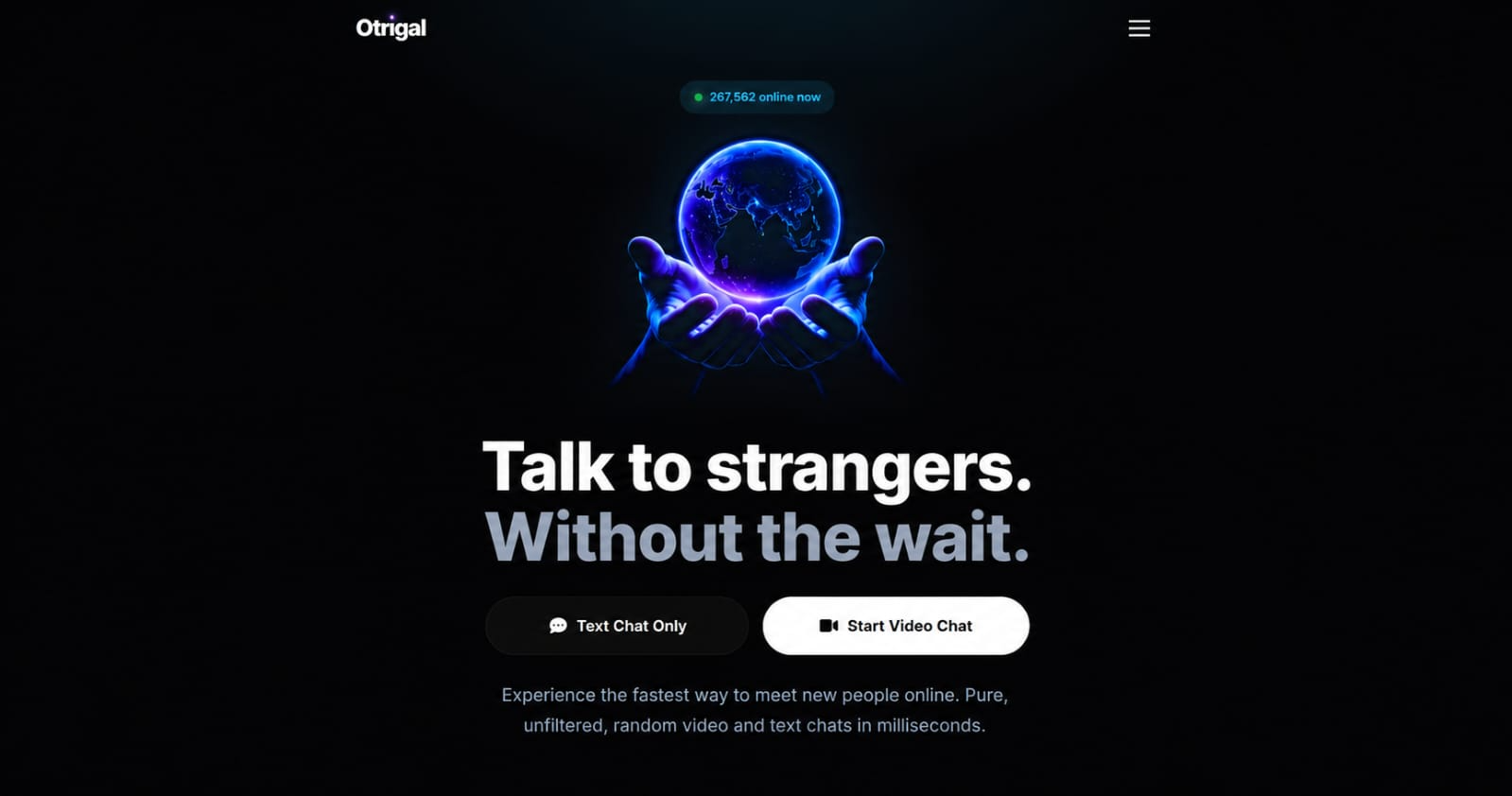
The Otrigal homepage one tap to start a video or text chat with a stranger.
History Repeats at Eighteen
Here is where the story turns poetic. In 2009, an 18-year-old named Leif K-Brooks built Omegle so strangers across the world could simply talk, with nothing in between. Fourteen years later, he admitted he could no longer keep fighting for it.
Now, another 18-year-old has picked up that fight. Otrigal’s founder, known publicly only as ARS Solanki, has chosen to keep his identity private, fitting for a platform whose entire promise is anonymity. What Otrigal offers its users, its founder has claimed for himself. It is a striking symmetry: genius in this space seems to arrive once a decade, always at the same age, and always at exactly the right time.
“Everyone’s built with a kind of magic. Most people never find theirs. I found mine in the work, because magic isn’t what you’re born showing; it’s what shows up when you outwork everyone watching. Fifteen years ago an 18-year-old named Leif K-Brooks built Omegle so strangers across the world could just talk, with nothing in between. He said he couldn’t keep fighting for it. So, one 18-year-old to another: I’ll take the fight from here. Built for the people who use it, secure enough to trust, open to anyone. I didn’t build it to be known. Let the work be the magic, not me.”
— ARS Solanki, founder of Otrigal
Whether this anonymous founder returns with bigger ideas remains to be seen. For now, he insists the work should speak, and the world gets to witness whether history truly repeats.
More Than Just Talking to Strangers
At its best, anonymous video chat has always been a tool for discovery. People use platforms like these to practise languages with native speakers, explore cultures they may never physically visit, and occasionally form friendships that outlast the conversation itself.
That promise has become rarer, not older. Today’s social platforms show people more of what they already know. Random video chat does the opposite. It reintroduces genuine serendipity to an internet that has largely engineered it away, and the platforms that can deliver it safely will define the category.
The Next Chapter
The future of anonymous video chat will not be written by any single company. It will be shaped by better technology, fairer moderation, stronger privacy standards, and teams committed to improving long after launch day.
Omegle proved the demand. Its successors proved the difficulty. Otrigal enters this new era not as a claim to replace the past, but as a contribution to the future of online social discovery.
One conversation at a time.
About Otrigal: Otrigal is a browser-based platform for random video and text conversations, accessible worldwide at otrigal.com.
